
With the meteoric rise of the wearable technology, the connected watches will continue to revolutionise sport in 2025. These intelligent devices have become essential allies for sports enthusiasts and professionals alike. Thanks to their combination of advanced functions, precise sensors and improved battery life, today's sports watches allow users to keep track of their sporting activities. activity monitoring to better understand and improve its performance.
This year's smartwatch trends place particular emphasis on robustness, precision and reliability. GPS watches, Our selection of the six best connected sports watches of 2025 is based on a comprehensive analysis based on rigorous field tests, designed to help you choose the ideal model for your specific needs. Our selection of the six best connected sports watches in 2025 is the result of a comprehensive analysis based on rigorous field tests, designed to help you choose the ideal model for your specific needs.
Whether you're a keen runner, trail runner, swimmer, cyclist or gym trainer, there's a device to suit everyone, with some surprising innovations, such as improved oximeter or optical cardio sensors. We'll also look at the importance of good battery life and a comfortable design for prolonged use. This expertise will enable you to navigate easily in a market rich in technical options and varied models.
In brief:
- 🌟 Sports connected watches in 2025 combine GPS precision and smartwatch analysis for high-performance tracking.
- 🔋 Extended autonomy is a major criterion, enabling long sessions, particularly on trails or hikes.
- 💡 Ergonomics and comfort of use on the wrist are essential, with models that are both robust and lightweight.
- 📊 Smart features like music control, payments and fitness tracker apps enrich the user experience.
- ⚙️ There's a wide range of products to suit every discipline and offer excellent value for money, from affordable bracelets to ultra-robust premium watches.
Top sports GPS watches in 2025: essential selection criteria
Choosing a connected sports watch in 2025 requires a detailed knowledge of the technical and practical criteria that can transform your training experience. Accurate geolocation remains at the heart of this choice. Indeed, having a dual-frequency GPS chip is now an important asset for guaranteeing faultless positioning and navigation, even in complex areas such as canyons or dense urban environments.
Wrist comfort is also essential, as a watch that is too heavy or ill-fitting will interfere with biometric data monitoring, particularly the optical heart rate monitor. A good balance between robustness and lightness is required. Titanium is becoming increasingly popular, offering an excellent strength-to-weight ratio, especially on top-of-the-range models. Furthermore, the quality of the screen has an impact not only on visual comfort but also on energy consumption: between high-resolution OLED screens and MIP LCD screens, the choice has an influence on battery life.
Speaking of autonomy, this is clearly a key criterion for endurance athletes. A high-performance watch must be able to keep up with several consecutive sessions, without needing to be recharged frequently. So we've ranked the watches according to their battery life during active GPS use, which is the most energy-intensive area.
- 📍 GPS accuracy (with dual-frequency chip)
- 🛡️ Robustness and materials
- ⌚ Comfort and ergonomics (weight, size, strap)
- 🔋 Autonomy in GPS mode
- 📱 Ease of use and interface quality
- 🎯 Specific sports functions (heart rate, power, navigation)
| Criteria | Impact on sporting activities | Example in 2025 |
|---|---|---|
| Dual-frequency GPS accuracy | Allows ultra-precise positioning, important for trail running and cycling | Coros Pace 3, Garmin Fenix 8 |
| Robustness (titanium, steel, polymer) | Resistance to impact and harsh conditions | Garmin Fenix 8 (titanium), Suunto Race (reinforced polymer) |
| GPS autonomy | For long sessions and ultra-endurance | Suunto Race - 40h, Coros Pace 3 - 30h |
| Ergonomics | Comfortable to wear for long periods and reliable measurements | Xiaomi Smart Band 9 (lightweight), Garmin Forerunner 265 (compact) |
| Advanced functions (music, payment) | Enriches the sporting experience and simplifies use | Garmin Fenix 8, Garmin Forerunner 265 |
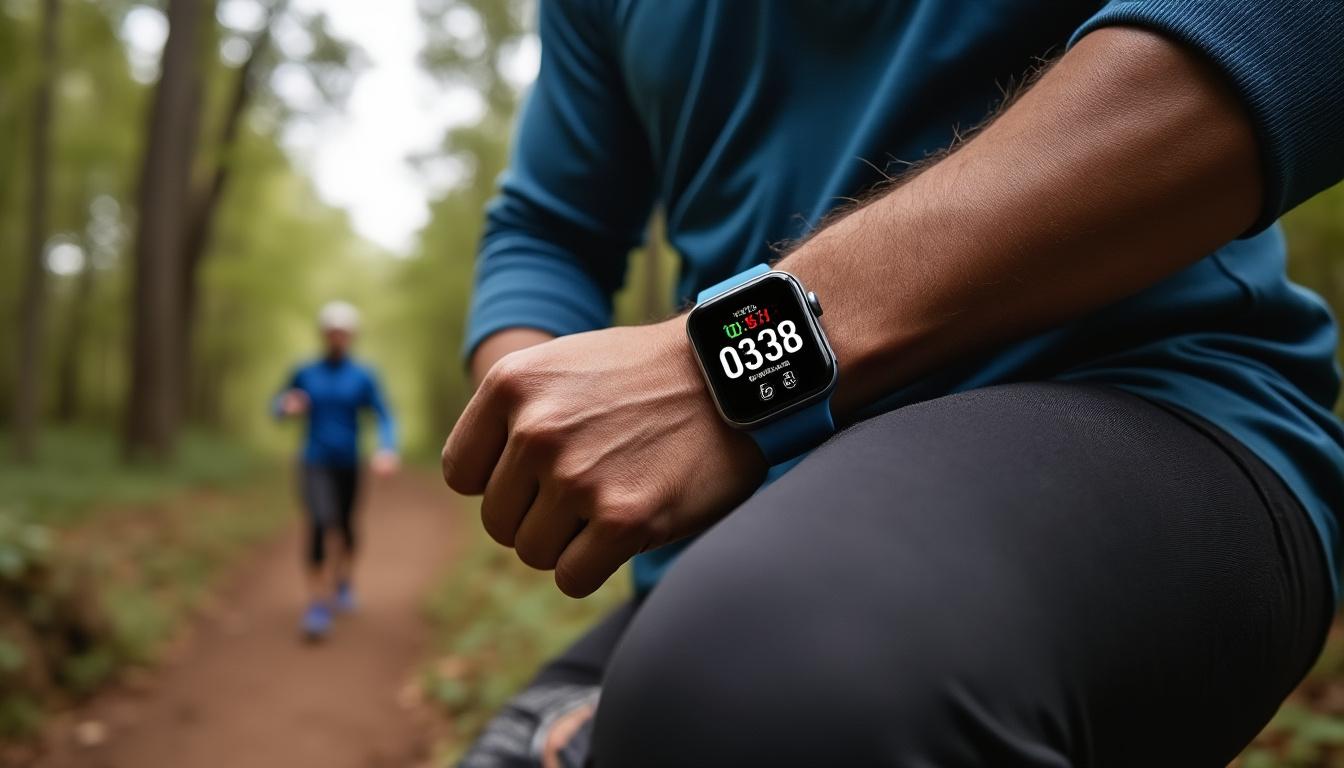
The best connected sports watches 2025: discover the top models
Let's take a look at the six must-have models that are dominating the market this year thanks to their performance, reliability and build quality. Each watch responds to a particular sportsperson's profile and combines the best of both worlds.’smartwatch analysis The new design is adapted to the physical requirements.
Garmin Fenix 8: the benchmark for performance and endurance
The Garmin Fenix 8 is positioned as the most complete and robust sports watch of 2025. With its large, bright OLED display and titanium or steel bezel, it can withstand diving to a depth of 40 metres thanks to its reinforced water-resistance. It has a loudspeaker and a microphone, enabling you to make calls and launch voice commands, a rare innovation in this category.
The sensors are protected, and the GPS and cardio-tracking systems are professional-grade. It offers integrated mapping with dynamic guidance, making navigation easier in real time. Its simplified interface makes it more intuitive to use, even if it does take a while to get used to it.
Its battery life is another strong point, but choosing the version with MIP LCD screen means you can get up to several weeks' use without recharging, ideal for ultra-sportsmen and adventurers.
Coros Pace 3: a sporty choice at a smart price 📉
For those looking for a compromise between performance and budget, the Coros Pace 3 is one of the best value for money models on the market. It features a dual-frequency GPS chip normally reserved for more expensive models, guaranteeing excellent accuracy.
Its optical cardio sensor has been improved, providing reliable readings for running, cycling and other sports. This lightweight, compact watch offers route tracking and advanced training features such as running power on the wrist and intelligent interval sessions.
The battery life is impressive, with up to 17 days' use without GPS, and 30 hours with GPS active, making it perfectly suited to long sessions, particularly trail running. Its plastic design and simple appearance stand out from other top-of-the-range watches, but its technical efficiency more than makes up for it.
Xiaomi Smart Band 9: the affordable, versatile sports watch
In the fitness tracker The Xiaomi Smart Band 9 still dominates in 2025. This connected wristband features a dynamic AMOLED screen and a featherweight, perfect for those looking for discretion.
Without built-in GPS, it relies on the smartphone for location, but its range of over 150 sports tracked, sleep and stress monitoring, and constant heart rate measurement make it a complete tool for beginners and amateurs alike. The simplicity of its interface and its very affordable price make it a good choice for everyday use.
Technological advances in connected sports watches in 2025
La wearable technology for sports watches will undergo a veritable revolution in 2025, with ever more precise sensors and major improvements in the processing of health and sports data. Advances in cardio optical sensors mean that heart rate can now be tracked instantly and ultra-reliably, even during intense exertion or sudden movements.
Geolocation is also at the heart of the innovations, with the widespread use of dual-frequency GNSS chips that use GPS, GLONASS, Galileo and BeiDou simultaneously, maximising accuracy in all environments. Sports watches incorporating this technology now far surpass their predecessors in terms of analytical precision.
Other notable new features include blood oxygenation monitoring (pulse oximeter) and stress detection, which are increasingly refined to offer users advice on recovery and adaptation to exercise. These elements are now indispensable in top-of-the-range watches.
Lastly, connectivity between the watch and smartphones, as well as with sports data platforms, is being improved to offer an enhanced range of functions: smartphone-free music storage, contactless payment, and integration of third-party applications.
- 📡 Dual-frequency GNSS chips for ultra-precise GPS
- ❤️ New-generation optical cardio sensors
- 🩸 Advanced pulse oximeter and stress monitoring.
- 🎧 Improved connectivity (music, payments, apps)
- 🔄 Smooth synchronisation with dedicated mobile applications
| Technology | Sporting advantage | 2025 watches concerned |
|---|---|---|
| Dual-frequency GNSS sensors | Improved precision in dense or mountainous areas | Garmin Fenix 8, Coros Pace 3, Suunto Race |
| Advanced optical cardiac monitoring | Reliable measurements even under intense stress | Garmin Forerunner 265, Coros Pace 3 |
| Integrated pulse oximeter | Stress analysis and optimal recovery | Garmin Fenix 8, Suunto Race |
| Advanced connected functions | Enhanced versatility and comfort of use | Garmin, Xiaomi Smart Band 9 |
2025 running and trail watches: the specialist models to covet
For dedicated runners and trail runners, accurate tracking and robust equipment are paramount. Among the preferred choices in 2025, the Garmin Forerunner 970 is a must-have. This watch is in a league of its own, with fluid navigation, an optimised screen and advanced running analysis metrics, including wrist power, vertical oscillation and, of course, accurate cardio tracking.
Features such as personalised training suggestions and race strategies harmonise performance with accessible coaching for all levels. Its comfortable battery life of around 20 hours in GPS mode makes it versatile, whether for a fast 10 km or a demanding trail run.
Similarly, the Suunto Race is another highly sought-after option for trail runners, thanks to its integrated mapping and dual-frequency GNSS system, which guarantees perfect orientation in complex natural environments. Its battery life of around 40 hours is a real advantage for long hikes and ultra-trails. Its robust design and rotating crown make it easy to handle, even when wearing gloves.
- 👟 Garmin Forerunner 970: advanced metrics, solid autonomy
- 🌲 Suunto Race: topographical mapping and fine navigation
- ⏱️ High-performance cardio tracking and advanced ultrasound analysis
- 🏞️ Robust design for extreme conditions
- 📡 Dual-frequency GNSS for ultra-reliable geolocation
| Model | Main use | GPS autonomy | Special function | Approximate price (€) |
|---|---|---|---|---|
| Garmin Forerunner 970 | Running, triathlon | 20 h | Power analysis, PacePro coaching | 550 |
| Suunto Race | Trail, hiking, ultra-endurance | 40 h | Cartography, rotating crown | 500 |
Comfort, design and intelligent functions: the user experience at the heart of the sports watch market
Beyond technical performance, comfort and aesthetics are no longer secondary criteria. Wearing a watch for long periods of time has a direct influence on the quality of the measurements, the reliability of the monitoring and the acceptability to the user. A watch that is too cumbersome or poorly balanced is likely to be overlooked or to lead to measurement errors due to poor contact.
The design has also evolved a great deal: slimmer lines, noble materials such as titanium, and personalisation options make these watches more attractive in everyday use. The Garmin Forerunner 265, for example, is remarkably light, so you'll forget you're wearing it, with a high-quality plastic case and a bright OLED display.
Intelligent functionality completes the experience: music control, contactless payments via NFC and easy integration with third-party applications have become standard. This trend reflects a desire to unite active living and connectivity, without sacrificing style or performance.
- ✨ Lightweight and top-of-the-range materials such as titanium or aluminium
- 📱 Integration of «smart» functions (payment, music, notifications)
- 🎨 Customised dials and bracelets
- 🧤 Ergonomically designed for use outdoors, even when wearing gloves
- 🔧 Intuitive user interface and comprehensive mobile applications
| Appearance | Importance | Watches in 2025 recommended |
|---|---|---|
| Weight and shape | Influence on wearing comfort and sensor reliability | Garmin Forerunner 265, Xiaomi Smart Band 9 |
| Materials (Titanium, reinforced plastic) | Durability and aesthetics | Garmin Fenix 8, Coros Pace 3 |
| Connected functions | Enhanced overall experience | Garmin Fenix 8, Xiaomi Smart Band 9 |
| Intuitive interface | Speed of use, ergonomics | Coros Pace 3, Garmin Forerunner 265 |
What is the most accurate connected watch for GPS tracking in 2025?
The Garmin Fenix 8 and Coros Pace 3 are currently the best dual-frequency GPS watches, offering exceptional accuracy even in difficult terrain.
How do I choose the right watch for trail running?
Opt for a watch with a long battery life, built-in mapping and accurate GPS, like the Suunto Race. Comfort and robustness are also crucial.
How much autonomy can you expect from sports watches in GPS mode?
In 2025, the best watches will last between 20 and 40 hours in continuous GPS mode, depending on the model and the options used.
Are connected bracelets a good alternative to watches?
For basic use and a limited budget, bracelets like the Xiaomi Smart Band 9 offer good health and sports tracking, but without built-in GPS or advanced functions.
What are the advantages of smart functions on a sports watch?
They can control music, make contactless payments, receive notifications and use dedicated applications to enhance the sporting experience.
 English
 French
 Spanish
 German
 Dutch
 Italian
 Portuguese