
Faced with a critical health situation in the South-West, the vaccination campaign against lumpy skin disease (LDS) in cattle has got under way against a backdrop of a growing number of cases of the disease.’emergency and strong anger farmers. For several weeks now, farmers have been protesting vehemently against the policy of systematically slaughtering affected herds, provoking a conflict with the authorities. In this region where’agriculture is an economic and cultural pillar, the mobilisation is widespread, bearing witness to the protest faced with a crisis that is affecting both the public health and the survival of farms.
The first batches of vaccines arrived recently, targeting almost 750,000 cattle in a vast regulated zone including the Pyrénées-Atlantiques and Landes regions. The aim of this operation is to create an effective sanitary cordon to halt the spread of DNC, a contagious viral disease which poses a serious threat to the national herd. The Government, under pressure, is stepping up the campaign, deploying reinforced veterinary teams and cancelling holidays to maximise the pace.
Yet despite these efforts, tensions remain palpable. Farmers are demanding not only immediate vaccination, but also a halt to the mass culls, which they see as an unfair punishment that is decimating their livelihoods. Against this fiery backdrop, the scenario of a bitter struggle between health authorities and rural players continues to play out, with a race against time to protect the South-West from a major agricultural disaster.
Vaccination emergency in the South-West: a race against time to protect livestock
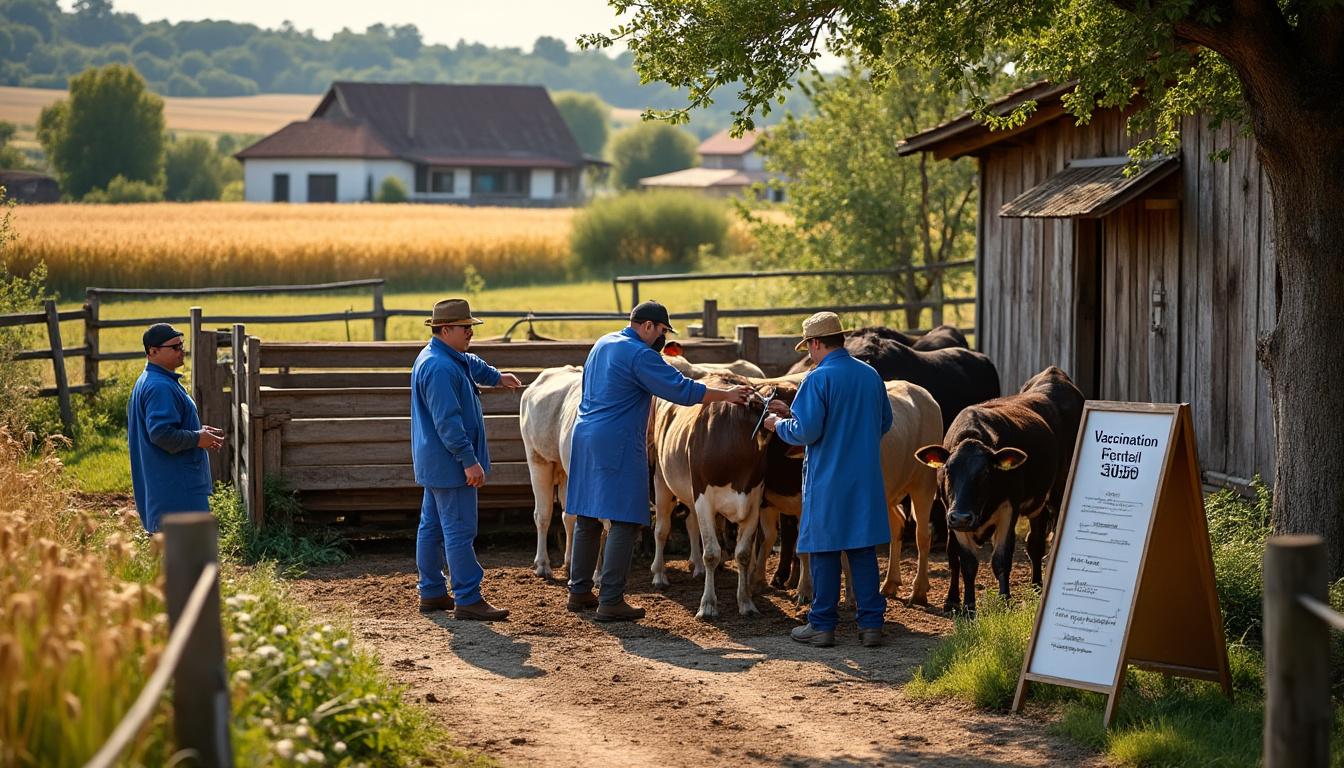
In the last days of 2024 and the beginning of 2025, the situation in the South-West of France took a turn for the worse, requiring an unprecedented acceleration in vaccination against lumpy skin disease. This viral disease, which is highly contagious between cattle, has led to the creation of a massive health plan. The aim? Immunise 750,000 cattle in a vast regulated zone covering eight departments in Occitanie as well as Landes and Pyrénées-Atlantiques.
The operation began with the arrival of an initial stock of 500,000 doses, supplemented by a rush order for a further 400,000 doses from a Dutch laboratory. Each animal will receive a single dose, providing protection for a period of 12 to 18 months. For the vaccine to have maximum effect, at least 75 % of the herd must be vaccinated, and animal movement is suspended in the area until herd immunity is acquired, around 28 days after the last injection.
This initiative is not just administrative; it reflects a major logistical and health challenge. The local authorities, under the leadership of Prefect Jean-Marie Girier, are mobilising not only practising vets, but also retired vets, military personnel and students in training to carry out this public health mission. They are all working around the clock, cancelling holidays and evenings, to keep up the pace of a titanic campaign aimed at stopping the virus before it devastates any more local farms.
Serge Marquis, a farmer in the Pyrénées-Atlantiques region of France, embodies this tension mixed with hope. After losing his duck farm to bird flu, he is now getting a breath of fresh air with the first doses of vaccine injected into his 91 white Aquitaine cows. His story clearly illustrates the pressure on farmers and the importance of mobilising against a disease whose damage has already led to the slaughter of almost 3,300 animals in the region.
Farmers' anger: demonstrations and blockades as part of an unprecedented mobilisation
The health context is generating protest farmers in the South-West, particularly in the worst-hit areas. These farmers are vigorously denouncing the strategy of’systematic culling of sick animals introduced by the authorities. This policy, which was supposed to stem the spread of lumpy skin disease, has given rise to a feeling of injustice and intense frustration among farmers.
In response, farmers have stepped up their blockades, notably stopping traffic on the A64 motorway at Pau-centre, the main artery in the Pyrénées-Atlantiques department. This escalation of the conflict reflects the scale of the anger This rural situation persists despite government announcements to speed up vaccination. The Coordination Rurale 64, while supporting the vaccination campaign, is maintaining its demands for an immediate halt to slaughter:
- 🚜 Blocking main roads to make farmers' voices heard
- 📣 Regular events in rural and urban areas
- 🛑 Call for a moratorium on the slaughter of positive animals
- 💉 Call for rapid, compulsory extension of vaccination throughout France
These protests are not isolated elsewhere in Occitanie, where vaccination, despite being launched as a matter of urgency, is struggling to ease tensions. The French Minister of Agriculture, Annie Genevard, had to travel to the region in person to demonstrate the government's determination to pursue its health policy and to witness the start of vaccination operations, which offer hope of a way out of the conflict.
Logistical and technical challenges of mass vaccination against lumpy skin disease
The rapid implementation of a vaccination campaign for almost a million cattle in the South-West of France represents a major logistical challenge. Managing stocks, coordinating the veterinary teams and monitoring the health of the farms affected requires meticulous organisation. These constraints make this operation one of the most ambitious ever carried out in the agricultural sector in recent times in France.
To maximise effectiveness, the State has secured a substantial stock of doses, but launching them simultaneously in several departments requires careful distribution based on precise criteria:
| Prioritisation criteria 🎯 | Description 📝 |
|---|---|
| Winter transhumance 🐄 | Priority should be given to vaccinating animals moving seasonally to avoid inter-regional contamination |
| Previously rehabilitated farms 🔄 | Priority to be given to farms already affected or which have undergone culls to prevent further contamination |
| Local breeds and selection centres 🐂 | Targeted protection of high genetic value livestock to safeguard the sector |
| Herd density 📊 | Increased intervention in densely populated areas to maximise effectiveness |
Mobilised vets work under intensive conditions, often contributing beyond normal working hours. They also include retired vets, specialist military personnel and veterinary students. This collaborative approach has been hailed by farming authorities as a sign of unity in the face of the crisis affecting the beef industry in one of its most emblematic regions.
To find out more about the accelerated mobilisation and emergency measures taken in the region, read this article on express mobilisation in Occitania.
Economic and social impact of the conflict on agriculture in the South-West
Over and above the health issues at stake, the lumpy skin disease epidemic is having a profound impact on the regional agricultural economy. The South-West, renowned for its cattle farming, is seeing its farms undermined by slaughter and the destabilisation of market prices. Many farmers are worried about the future of their business, and the anger reflects this disarray in the face of a double penalty: health and economic.
The loss of thousands of cattle in this region is leading to a direct fall in turnover, the crumbling of the rural fabric, and growing concern for future generations. On the ground, solidarity is nevertheless being organised, with local initiatives to support breeders, from pooling resources to facilitating access to vaccines.
To illustrate the scale of the situation, here are some recent key figures:
- 🐄 More than 3,300 cattle slaughtered since the start of the epidemic
- 💉 1 million cattle vaccinated to date
- 🚜 750,000 cattle targeted for vaccination by the end of January
- 📅 Priority vaccination in the 129 municipalities in the immediate vicinity of the infectious outbreak
Farmers are hoping that this strategy, which is very costly but necessary, will soon give their production a new lease of life. In the meantime, social tension remains palpable, with the risk of further demonstrations, as reported in this article dedicated to the emergency in Pyrénées-Atlantiques where vaccination has been launched across the board.
Prospects and expectations in the face of health mobilisation: towards a lasting calm?
As the vaccination campaign continues apace, all eyes are now on the concrete results that this operation can produce in the coming weeks. The hope is high: to immunise 75 % of the cattle herd in the affected areas in order to drastically limit the circulation of the virus. This is seen as the best way to restore the balance between health protection and farm survival.
The momentum generated could also serve as a model for the management of similar health crises in the future. The collaboration between vets, farmers, health authorities and trade unions is evidence of a collective awareness. The success of this campaign could ease tensions and allow local agriculture to breathe a sigh of relief. However, this transition still requires a great deal of effort, particularly in terms of dialogue between stakeholders.
Here are the main issues to follow:
- 💉 Continuation and extension of vaccination beyond priority areas
- ⚖️ Fair compensation for losses suffered by farmers
- 🗣️ Enhanced dialogue to prevent future health conflicts
- 🔬 Rigorous monitoring of disease progression to adjust measures
To find out more about the strategies involved, visit this comprehensive article on the express mobilisation to vaccinate the population. Vigilance remains the order of the day as the region enters a decisive phase in its development. public health and the sustainability of its agriculture.
What is lumpy skin disease and why is it dangerous?
Lumpy skin disease is a viral disease that mainly affects cattle. It causes skin nodules, reduces milk and meat production, and can lead to the herd being culled to prevent the disease spreading.
Why is vaccination essential in the fight against CND?
Vaccination makes it possible to immunise animals, thereby limiting contagion and avoiding the mass slaughter of herds. Vaccination coverage of at least 75 % is considered necessary to achieve effective herd immunity.
What are the main demands of the angry farmers?
Farmers are calling for an end to systematic slaughter, a rapid and compulsory extension of vaccination, and fair financial compensation.
How is the vaccination campaign organised?
The government has mobilised working, retired and student vets to give priority to vaccinating the areas most at risk. The suspension of animal movements completes this health measure.
What economic impact has the DNC crisis had on the South West?
The disease is causing a drop in milk and meat production, leading to significant financial losses and weakening farms, particularly high-value local livestock.
 English
 French
 Spanish
 German
 Dutch
 Italian
 Portuguese