
Emergency strategies, rapid defence and military responsiveness are essential keywords for understanding how the French army is preparing today to meet the challenges of blitzkrieg attacks. Faced with increasingly complex threats, growing geopolitical instability and hybrid forms of warfare, the nation must reinvent its military tactics and crisis management. These issues are of paramount importance in a tense international context, where national security is being put to the test at every turn.
In parallel with blitzkrieg operations, the French army is developing emergency response protocols to protect its strategic infrastructure, such as the air bases that house its fighter aircraft, particularly the Rafales. These forces must not only be able to cope with surprise attacks, but also to respond quickly by dispersing their resources to avoid significant losses. The «Topaze» exercise, for example, is a perfect illustration of this need for rapid, coordinated reaction, testing the dispersal capability of aircraft and inter-base coordination.
In this context, new technologies, drones and robotics are playing an increasingly important role. Anticipation has become the watchword for ensuring optimum defence against rapid enemy assaults, while cooperation between allies strengthens collective power. It is against this backdrop that the Air Force Air Brigade, under the command of General Pierre Gaudillière, engages in realistic exercises to maintain the high level of operational expertise that is essential for managing current and future crises.
Implementing emergency strategies in the rapid defence of French air bases
Faced with the risk of blitz attacks, the military responsiveness is primarily reflected in emergency strategies firmly rooted in operational protocols. The ability of an air base to defend itself while ensuring the security of its strategic assets is essential. During the Topaz, The Mont-de-Marsan base, renowned for its fleet of Rafales, found itself under threat from a fast-approaching armed drone. This simulation tested the teams' ability to detect, assess and respond to this imminent threat in just a few hours, demonstrating the importance of rigorous planning combined with rapid execution.
The military tactics employed to protect the precious fleet involved crucial decisions, including the dispersal of aircraft to several secondary bases. In this particular exercise, twenty aircraft and 145 personnel were spread over four different bases, including Cazaux, thus avoiding a severe impact on operational capacity.This method of dispersal not only speeds up the protection of equipment, but also limits potential human losses and increases overall resilience to attacks.
To complement this rapid defence, simulated breakdowns have been introduced to test the robustness of ground teams. This forces mechanics and logisticians to work under pressure and with limited information, reflecting a real emergency situation. The example of Captain Armand, a Rafale pilot, shows the importance of smooth communication despite short notice. Here, the crisis management is proving crucial, with the need for each player to act effectively, even in the face of uncertainty.
These exercises reinforce a culture of military responsiveness, The aim is to develop the reflexes that are essential for immediate and effective protection. Inter-service coordination, particularly with the army and air defence systems, is highlighted as a strong point in guaranteeing flexible responses to dynamic events.
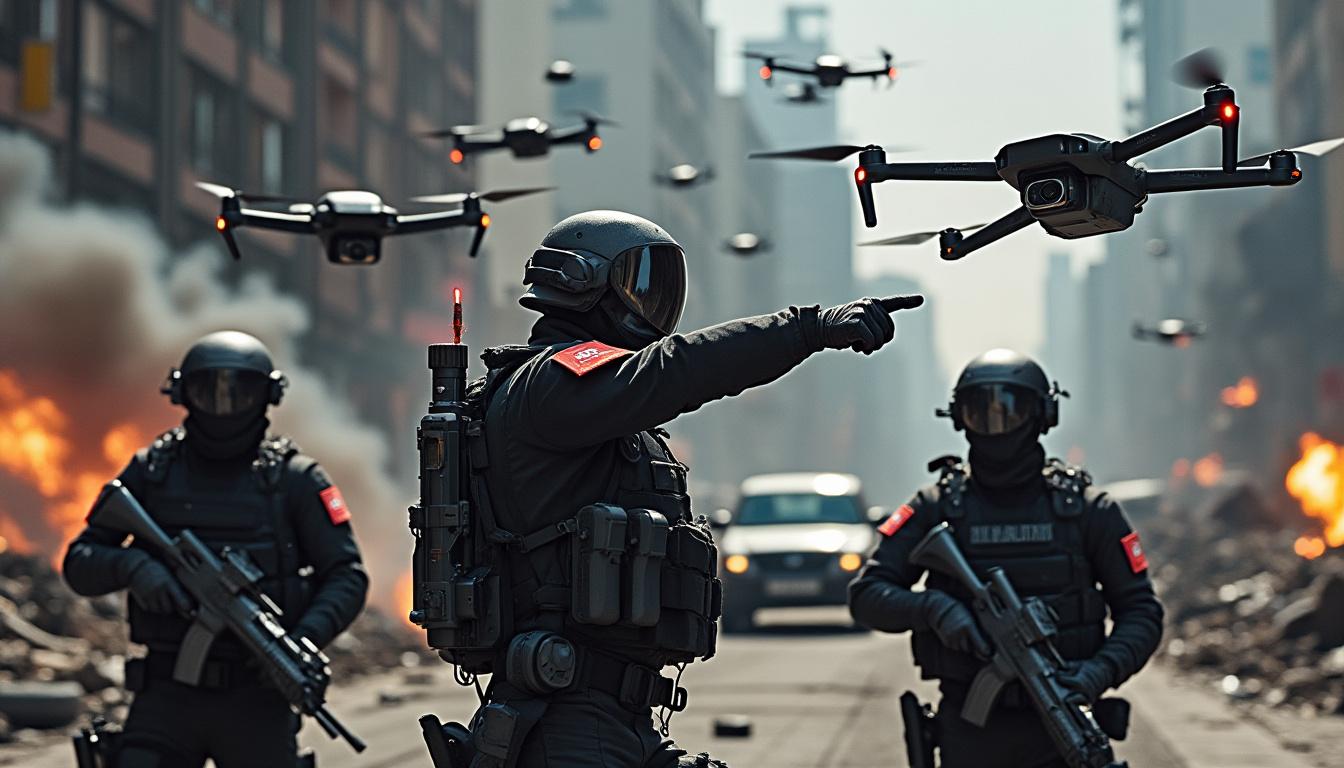
The tactical and technological challenges of modern blitzkrieg operations
For several years now, the nature of conflicts has been changing, with asymmetric and hybrid threats predominating, of which blitzkrieg attacks are the perfect example. L’French army is now faced with an increasing number of innovative forms of attack, notably by armed drones and autonomous robots, making the national security a challenge that requires constant adaptation of practices.
The challenges are many: how to detect a silent threat quickly, how to exploit technological advances to thwart these attacks, and above all, how to act before the attacker strikes at the heart of strategic infrastructures? Exercises such as «Topaze» highlight the importance of constant surveillance using advanced radar and sensors, while testing the speed of tactical responses, such as recalibrating air defences and instantly mobilising response units.
From a technological point of view, the integration of reconnaissance drones and autonomous ground robots gives forces a better tactical vision in real time and reduces the risks for soldiers. Beyond simple detection, these tools play an active role in neutralising threats, sometimes even before they reach their designated target. On-board artificial intelligence systems and predictive algorithms ensure better anticipation of blitz attacks, which is essential for rapid and effective crisis management.
To better illustrate these advances, here is a table summarising the key technologies currently being developed or used in rapid defence against these types of attack:
| 🛡️ Technology | ✨ Main function | ⚙️ Example of use |
|---|---|---|
| Surveillance drones | Rapid detection and recognition | Searching for enemy drones in flight |
| Autonomous ground robots | Neutralising explosives and security patrols | Managing dangerous post-attack terrain |
| Advanced radar systems | Multiple tracking of aerial targets | Precise identification and targeting |
| Predictive AI | Anticipatory threat analysis | Simulation of attack scenarios |
These innovations, while encouraging, require ongoing training for soldiers and commanders, accentuating the need for regular exercises and sharing of experience with international partners. In recent years, collaboration with allied forces on courses such as the Tactical Leadership Programme in Spain has strengthened the ability of French units to operate in a connected and interoperable environment.
The crucial importance of psychological and logistical preparation for military crisis management
The success of an effective defence against blitzkrieg attacks depends on more than just technology and military operations. The mental preparation of soldiers and rapid logistics play a decisive role in their ability to overcome situations of extreme stress.
During the «Topaze» exercise, the tensions were palpable: short notice, simulated breakdowns, a simulated real threat that forced the teams to react with composure. Captain Armand insists on this dimension: «The key is discipline and confidence in procedures. You need to have the intuition to act quickly, but also to be able to adapt to the unexpected.»
From a logistical point of view, dispersing aircraft, organising rapid rotations for maintenance and ensuring the supply of troops under fire are complex operations. Coordination between several bases and services is essential to ensure that each unit can respond without delay. In addition, the multiplicity of threats means that several crises have to be managed simultaneously, a constant challenge for commanders.
To illustrate these needs, here is a list of key actions in the logistics of an emergency response:
- 🚀 Rapid dispersal of airborne resources to limit losses
- 🔧 Maintenance in critical conditions with limited time
- 📡 Coordination between several sites for real-time information exchange
- 🚨 Priority management of immediate threats based on available capacities
- 🛠️ Systems redundancy to ensure continuity of operations
The army must also incorporate psychological training into this preparation, to ensure that the men and women at the front understand the importance of constant vigilance and know how to handle the pressure without wavering. It is this multidimensional character that guarantees the solidity and resilience of military forces in the face of lightning attacks.
Lessons learned from the war in Ukraine and their impact on French doctrine
The Ukrainian conflict, which is still ongoing, has been a vital testing and learning ground for Europe's military staffs. For France, it is a practical example of high-intensity warfare, with regular blitzkriegs, hybrid manoeuvres and massive use of drones.
Lessons learned highlight the absolute need to modernise doctrines and equipment. Hitherto focused on asymmetric and anti-terrorist conflicts, the’French army must now align itself with a war where speed and striking power are paramount.
General Pierre Gaudillière sums up this urgency: «We never train for nothing. The high-intensity warfare now raging on several fronts requires us to be faster, more precise and more adaptable. This doctrinal change has led to an increase in Topaze-type exercises, but also to massive investment in equipment.
The conflict has also highlighted the importance of solid alliances and enhanced cooperation between European armies, hence the growing number of international training courses and exchanges of resources. The aim is twofold: to strengthen the cohesion of intervention forces and to accelerate the rise in technological power in the face of growing threats.
To find out more about blitz operations and their preparation in an international context, read this article about the urgent challenges facing emergency services in critical situations, which illustrates how speed and efficiency are key to success in critical contexts.
Evolution of French military strategies in the face of hybrid threats and rapid attacks
France, like many NATO member states, is now faced with a multidimensional war. This war is not limited to traditional battlefields, but also extends to cyber attacks, sabotage and blitzkrieg combined with hybrid forms of warfare. Emergency strategies are therefore at the heart of an agile defence, combining anticipation, speed of execution and versatility.
In this context, the use of drones and robots is becoming common practice, both for surveillance and for offensive and defensive operations. France is also developing electronic warfare systems aimed at neutralising the communications and guidance systems used by the enemy, thereby consolidating its capacity for rapid and effective defence.
Here's a summary of how French military blitzkrieg strategies are evolving:
- 📌 Continuous improvement of detection and warning capabilities, with a reinforced radar and sensor network.
- 📌 Modernisation of combat resources, integrating drones, automatic systems and AI for integrated cyber-physical combat.
- 📌 Intensified training for soldiers for greater responsiveness to multiple threats.
- 📌 Increased international cooperation, particularly with our European and American allies.
- 📌 Strengthening emergency response doctrines, This allows us to adapt quickly to unexpected scenarios.
This constant adaptation is essential in a world where traditional warfare is now mingled with hybrid conflicts, a terrain where the’French army is constantly preparing to guarantee national security in the face of any form of aggression. This is an area in which crisis management plays a major role.
To find out more about the importance of speed in managing unforeseen events, read this article on the race against the clock linked to the vagaries of the weather. which illustrates the urgency of critical situations.
What are the main objectives of emergency strategies in the French Army?
Emergency strategies are designed to ensure a rapid and effective response to sudden threats, by protecting strategic bases, dispersing resources and ensuring fluid coordination between units.
How is the French army adapting to drone strikes?
It is investing in advanced technologies such as radar, artificial intelligence and autonomous robots, while conducting regular exercises to improve military responsiveness and coordination between bases.
What role does international cooperation play in rapid defence?
Cooperation enables the sharing of experience, improved tactics and greater interoperability between allied forces, which is crucial in the face of modernised and hybrid threats.
Why is psychological preparation important for soldiers?
It enables soldiers to maintain their composure and act effectively under pressure, especially in high-intensity situations where rapid decision-making is vital.
What are the new strategic directions in the face of the hybrid threat?
They include strengthening detection capabilities, modernising equipment, stepping up training and adapting doctrines to rapid and hybrid threats.
 English
 French
 Spanish
 German
 Dutch
 Italian
 Portuguese